

Physical inventory helps verify that the fixed assets recorded in SAP are still present. Assets that are missing or no longer in use require investigation and the appropriate accounting treatment. The individual objects in fixed assets must be recorded so they are identifiable.
The inventory is the record (directory) of individual asset objects. This directory must report the asset objects present on a specified date. These objects must be determined by a physical check, also known as a physical inventory. The word inventory is derived from the Latin invenire, meaning to find something. In this blog I explain what you have to list in the fixed assets inventory and how to perform the physical check.
Release context: Joerg Siebert’s original article and figures describe classic SAP Asset Accounting. ERPCorp has refreshed the formatting and added SAP references. Inventory frequency and evidence requirements depend on the applicable rules and company policy. With Universal Parallel Accounting, quantities are no longer stored in the asset master record; quantity postings are recorded in the Universal Journal. Read the classic master-data screenshots below in that context.
Physical Inventory Basics
National tax and accounting laws regulate the information the inventory directory must contain. These laws also regulate how and at what time intervals a physical inventory must take place.
You verify that the individual assets listed in the inventory directory are present by a physical inventory, meaning the assets should be viewed and counted individually, which can be a very time-consuming measure.
Accountants are often accused of being bean counters. Apart from the fact that this statement is not a compliment, it is also incorrect. The effort involved in checking and reporting the value of fixed assets can, and must be kept within reasonable limits. The principle of proportionality is also applicable.
Quantity Management in Fixed Assets
You can manage identical capital goods in the inventory as a single item with a quantity. In the sense of valuation, identical means the following:
- Identical date of acquisition
- Identical acquisition and production costs
- Identical depreciation method
For example, 50 personal computers could be managed under one asset number. This variant for the master asset (unfortunately frequently used) will lead to more effort later in the maintenance of asset balances. For example, these 50 personal computers will not leave the company all at the same time. Time-consuming partial retirements are necessary, and they will also not be used permanently in one cost center, thus requiring extensive partial repostings instead of simple cost center changes.
This type of inventory management causes the greatest problems for a physical asset inventory. How can you determine whether all 50 computers of this asset are still present? The individual PCs cannot be identified via asset accounting. Evidence of existence is still required at the frequency specified by the applicable accounting requirements and company policy. This evidence would require additional individual inventory management outside or in addition to asset accounting. Thus the company still has the administrative effort and there is therefore no benefit.
We advise against this type of inventory management. SAP Asset Accounting offers convenient functions for creating and posting this type of mass acquisition with the initial purchase. You can address these with the Hierarchy of Asset Master Records.
Quantity Examples
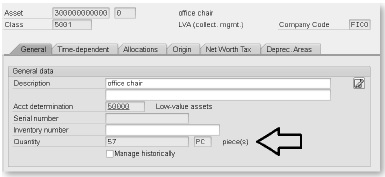
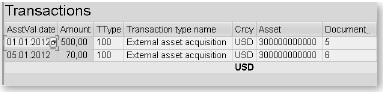
Quantity details are however still useful for certain capital goods, for example, for low-value assets that are presented as flat-rate assets. Figure 1 shows an asset with a quantity of 57 items, and Figure 2 shows the movements for this asset.
Real Estate Units and Ownership Evidence
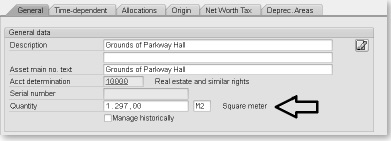
For real estate, we recommend specifying the number of square meters, as shown in Figure 3.
A physical inspection does not by itself establish legal ownership of real estate. Ownership evidence is typically supported by the applicable land or deeds register and the corresponding plot identification.
About Joerg Siebert
Visit Joerg Siebert’s ERPCorp profile for his biography, learning resources, and speaker interview.
Joerg Siebert has 20 years of experience working with SAP Financials and is an internationally recognized author, speaker, trainer, and veteran SAP consultant. He has worked throughout Europe in the automotive, healthcare, and service industries and regularly delivers sessions at international SAP conferences. Previously, Joerg was a product manager for SAP ERP Financials at SAP German headquarters.
He is the Co-founder and Managing Director of Espresso Tutorials, a publishing company focused on short and concise SAP textbooks.
Contact Joerg at
Related Reading and SAP References
- SAP S/4HANA Asset Accounting: Book Overview
- SAP: Generating the Inventory List — define the inventory scope, prepare lists, process results, and record the inventory date.
- SAP: Asset Lists — the classic inventory list selects assets with the inventory indicator set.
- SAP: Universal Parallel Accounting — release-specific quantity handling and Asset Accounting changes.
Improve Your SAP Finance and Asset Reporting
ERPCorp helps finance teams review SAP Finance and Controlling processes, master data, reporting, and period-end requirements. Discuss your asset reporting and integration needs with our consulting team.
Continue Learning SAP Finance and Controlling
Explore practical sessions and connect with fellow SAP professionals at the next SAP Controlling Conference.