
Introduction
SAP Product Cost Controlling in S/4HANA provides the tools to plan product costs, calculate standard costs, collect actual manufacturing costs, analyze work in process and production variances, and settle costs at period end.
This guide provides an overview of the complete Product Cost Controlling process in SAP S/4HANA - from master data and cost estimates through Cost Object Controlling, Material Ledger and Actual Costing, Event-Based Production Costing, and reporting.
It also explains the differences between SAP S/4HANA On-Premise, Private Cloud, and Public Cloud where they affect Product Cost Controlling.
Quick Takeaway
SAP Product Cost Controlling connects product cost planning with manufacturing execution and period-end accounting. It helps organizations understand what products should cost, what they actually cost, and why differences occur.
SAP Product Cost Controlling Overview
- In our latest S/4HANA edition, discover everything you need to know about product costing
- We explore planning, cost estimates, cost object controlling, reporting with many examples
SAP S/4HANA Deployment Options
SAP Product Cost Controlling is available across SAP S/4HANA deployment models, but functionality and configuration options vary between On-Premise, Private Cloud, and Public Cloud.
Understanding these differences is important when designing Product Costing processes or planning an S/4HANA transformation.
Throughout this guide, when we explain transactions and describe the configuration settings, the screens are identical for SAP S/4HANA Cloud Private Edition and on-premise SAP S/4HANA. We don’t specifically explain SAP S/4HANA Cloud Private Edition settings. When we explain how to run SAP S/4HANA Cloud Public Edition, the business transactions are via SAP Fiori (a web interface) rather than the SAP GUI. System configuration is largely delivered through SAP Best Practices, with additional configuration available through Self-Service Configuration UIs (SSCUI).
When we discuss SAP S/4HANA Cloud, we mean SAP S/4HANA Cloud Public Edition. The SAP Fiori user interface is role-based, and we begin instructions with the application’s default role and then explain how to find the tile to run the application. If you use SAP S/4HANA Private Edition or SAP S/4HANA On-Premise, you can choose whether you use SAP GUI transactions or SAP Fiori. We give you the transaction code and the menu path for every SAP GUI application. For example, to create a material cost estimate, you can either enter Transaction CK11N, as shown in Figure 1, or follow the menu path Accounting • Controlling • Product Cost Controlling • Product Cost Planning • Material Costing Cost Estimate with Quantity Structure • Create. Figure 1 shows both the transaction code and the menu path. Both options will take you to the Create Material Cost Estimate with Quantity Structure screen shown in Figure 2, and from then on, the instructions are identical.

Continue Your SAP Product Costing Journey
For a comprehensive treatment of SAP Product Cost Controlling, see Product Cost Controlling with SAP S/4HANA by John Jordan and Janet Salmon.
Save 15% with your personal coupon code JORDAN15.
Product Cost Controlling with SAP S/4HANA
Need Help With SAP Product Costing?
ERPCorp provides specialized SAP consulting to help organizations optimize Product Costing, Finance & Controlling, and S/4HANA—improving cost transparency, manufacturing cost analysis, financial processes, and profitability.
Explore SAP Consulting Services
SAP Product Cost Controlling Topics
-
Chapter 1: Initial Planning
-
Chapter 2: Controlling Master Data
-
Chapter 3: Material Master Data
-
Chapter 4: Logistics Master Data
-
Chapter 5: Costing Sheets
-
Chapter 6: Cost Components
-
Chapter 7: Costing Variant Components
-
Chapter 8: Costing Variant Tabs
-
Chapter 9: Standard Cost Estimates
-
Chapter 10: Preliminary Costing for Production Orders
-
Chapter 11: Simultaneous Costing
-
Chapter 12: Overhead Calculation
-
Chapter 13: Work in Process (WIP)
-
Chapter 14: Variance Calculation
-
Chapter 15: Settlement
-
Chapter 16: Material Ledger and Actual Costing
-
Chapter 17: Sales Order Controlling
-
Chapter 18: Special Product Costing Topics
-
Chapter 19: Event-Based Production Costing
-
Chapter 20: Product Cost Controlling Reporting
-
Glossary
Chapter 1: Initial Planning
You first follow a best-practice scenario, shown in Figure 1, that includes Sales and Operations Planning (S&OP) and long-term planning runs.
To initiate integrated planning, you create sales plan quantities in Profitability Analysis (CO-PA) or S&OP and convert them into a production plan that you then transfer to demand management.
Note:
SAP Integrated Business Planning (IBP) for Supply Chain will gradually replace S&OP.
Long-term planning determines work center loads and purchasing requirements. Activity quantities are transferred to Cost Center Accounting (CCA), where you determine plan activity prices.

Figure 1: Sales and Operations Planning
You plan procurement and production costs and set prices for materials and services. First, you determine the purchase price for externally procured items, and then the manufacturing cost for assemblies.
The following master data and configuration chapters describe the setup to create cost estimates.
Master data is information that stays relatively constant over long periods. The following three chapters detail master data for Product Cost Planning, providing many examples and case scenarios.
Chapter 2: Controlling Master Data
We discuss CO master data, including cost elements, cost centers, activity types, and statistical key figures, as shown in Figure 2.

Figure 2: Maintain GL Accounts Centrally
You'll learn about the cost of sales G/L accounts, how to swap the cost center standard hierarchy, and activity type groups.
Chapter 3: Material Master Data
As shown in Figure 3, we examine material master views, including Material Requirements Planning (MRP), Controlling (CO), and Accounting (FI).

Figure 3: Change MRP2 View
We also examine:
- ABC indicator
- Fixed lot size
- Discontinued materials
- Material Ledger documents
- Actual cost component split
Chapter 4: Logistics Master Data
We examine logistics master data, including bills of materials (BOMs), routings shown in Figure 4, product cost collectors, and purchasing info records.

Figure 4: Example BOM and Routing
We also examine more specific topics, including recursive BOMs, product cost collector lists, plant-specific purchasing info records, source lists, and production versions.
Configuration
Most configuration settings are made when you first implement SAP. All configuration settings are closely controlled and monitored because they significantly impact your company's system process design. We explain the configuration in the following four chapters:
Chapter 5: Costing Sheets
Costing sheet configuration determines how cost estimates calculate overhead costs. A base cost is multiplied by a rate to debit a production order and credit a cost center. We examine costing sheets and how they are used to set up overhead calculation, as shown in Figure 5.

Figure 5 Costing Sheet
In the previous three chapters, we discussed Controlling, material, and logistics master data, which provide cost estimates with the quantity and price information necessary to calculate the standard cost to procure or manufacture a material. This chapter discusses costing sheet configuration, which determines how cost estimates calculate overhead costs. We will explore overhead costs, the base to which overhead costs are applied, the overhead rate, and the credit key.
In addition to direct material and labor costs, overhead costs are typically included as a separate component of the finished product standard price. Overhead costs may consist of building lease, insurance, and general office staff not directly involved in production.
Chapter 6: Cost Components
For reporting purposes, we analyze cost components and structures and how they group similar costs, such as material, labor, and overhead, as shown in Figure 6.

Figure 6: Cost Components
We also look at how cost component groups can improve your reporting by making cost components available in standard cost estimate lists.
Chapter 7: Costing Variant Components
We examine in detail how you set up costing variant components that contain the configuration required to create cost estimates, including:
- Costing Type
- Valuation Variant
- Date Control
- Quantity Structure Control
- Transfer Control
- Reference Variant
You display a costing variant with Transaction OKKN as shown in Figure 7.

Figure 7: Standard Costing Variant PPC1
We also include detailed information on delivery costs for purchased materials.
Chapter 8: Costing Variant Tabs
We examine how you set up costing variant tabs that contain the configuration required to create cost estimates, including:
- Control
- Quantity Structure
- Additive Costs
- Update
- Assignments
- Miscellaneous
Chapter 9: Standard Cost Estimates
We discuss creating, marking, and releasing standard cost estimates to update the standard price and revalue inventory, as shown in Figure 9.

Figure 9: Create Standard Cost Estimate
We examine the mark and release process and costing runs, which automate the mass processing of standard cost estimates. We include information on marking allowances and optimizing costing runs.
Chapter 10: Preliminary Costing for Production Orders
We detail how preliminary cost estimates calculate the planned costs for manufacturing orders and product cost collectors, as shown in Figure 10.

Figure 10: Change Product Cost Collector
We analyze how preliminary cost estimates plan costs for cost objects such as manufacturing orders and product cost collectors based on order type configuration, as shown in Figure 12.

Figure 12: Preliminary Cost Estimate
Chapter 11: Simultaneous Costing
We also look at how unit cost estimates are designed for use during the product development phase.
In simultaneous costing, we examine how actual costs, such as component and sub-assembly goods issues and activity costs, are posted to cost objects during production order and process order activity confirmations, as illustrated in Figure 11.

Figure 11: Goods Issue to Production Order
We also cover default activities and operation sequences, Margin Analysis, and detailed reports.

Figure 11a: Unit Cost Estimate for Product Development
Unit cost estimates are easily changed because they follow a spreadsheet format, as shown in Figure 11a, which is ideal for a development environment.

Cost Object Controlling allows you to determine planned costs for cost objects, post actual costs, and analyze variances, as discussed in the following chapters.
Chapter 12: Overhead Calculation
We examine how you perform period-end overhead calculations, as shown in Figure 12, based on the costing sheet configuration discussed in Chapter 5.

Figure 12: Overhead Calculation Results Screen
Chapter 13: Work in Process (WIP)
We examine how work in process (WIP) is configured and how the period-end step is executed, as illustrated in Figure 13.

Figure 13: Assign Cost Elements For WIP and Results Analysis

Chapter 14: Variance Calculation
We examine production variance configuration, period-end processing, and analysis, and provide examples of the types of variance calculations, as shown in Figure 14.

Figure 14: Variance Calculation Selection Screen
We also discuss how SAP S/4HANA improves variance calculation performance.
Chapter 15: Settlement
We analyze settlement configuration and period-end processing, as shown in Figure 15. We discuss settlement and processing types, including the allocation and PA transfer structures.

Figure 15: Settlement Rule Parameters
We examine new transactions available with SAP S/4HANA.
Chapter 16: Material Ledger and Actual Costing
Actual Costing uses the Material Ledger to collect price and exchange rate differences for materials during the period. Goods movements are initially valuated at the standard price. At period end, these differences can be allocated to calculate an actual weighted average price, known as the periodic unit price (PUP).
Actual Costing can also support the capitalization of production variances by calculating actual costs for manufactured goods. This chapter explores the configuration, setup, and execution of Actual Costing.
Chapter 17: Sales Order Controlling
Sales order costing scenarios involve customer orders that require you to procure components or assemblies manufactured for individual customers or orders.
Because the customer's sales order involves special requirements, you need to treat the costing of sales orders individually. You cannot generally use the standard costs for the material ordered by the customer, but must adjust the cost estimate to reflect the customer's specific requirements.
The first indication that Sales Order Controlling is involved in a process is the requirements type, which you find in the Procurement tab of a sales order line item. You display a sales order with Transaction VA03 or via the menu path Logistics • Sales and Distribution • Sales • Order • Display. You may find it easier to locate a sales order by displaying a list with Transaction VA05.
You can also manage sales orders with the Sales Order app (SAP Fiori ID F1814).
Chapter 18: Special Product Costing Topics
We discuss configuration and period-end processing for:
- Subcontracting
- Delivery costs
- Stock in transit
- Overhead templates
- Mixed cost estimates
- Cost estimate user exits

Figure 18: SAP Material Ledger Actual Costing Without Revaluation
Chapter 19: Event-Based Production Costing
Event-based production accounting is only supported with Universal Parallel Accounting (UPA). In this section, we’ll look at the configuration settings that control the posting logic for calculating overhead, WIP, and production variances. We’ll then explain how the system calculates overhead, WIP, and production variances and captures them as the underlying business transactions.
When moving to event-based production accounting, you can keep the overhead calculation rules we saw in Chapter 5, but you must flag your costing sheet as event-based, as shown for Costing Sheet 1010EP in Figure 19.15. It’s not possible to combine non-event-based costing sheets with event-based WIP because the assumption is that the creation of the reference document will trigger a first follow-on document for the overhead, followed by a follow-on document for either WIP or production variances, depending on the order status.
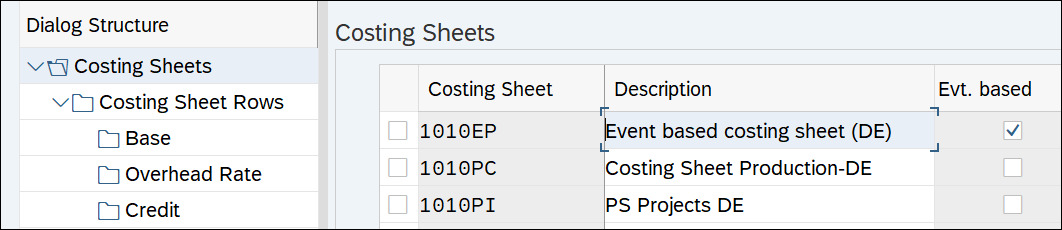
Figure 19.15 Costing Sheet for Event-Based Production Accounting
You determine that a production order, a process order, or a product cost collector should generate journal entries for WIP and production variances by assigning the appropriate Event-Based Processing Key to the order. As we saw for WIP calculation in Chapter 13, the default key is selected using the order type and plant combination. Figure 19.16 shows the event-based processing key for production orders, which combines the settings for WIP calculation, variance calculation, and potential settlement receivers. Notice that if you use this key, WIP is calculated at actual costs, and variances (if calculated) can be split into the categories Input Price Variance, Input Quantity Variance, Resource Usage Variance, Lot Size Variance, and Remaining Variance, and it’s possible to assign some costs to cost centers or WBS elements rather than assigning all costs to the material. To access these settings, choose Controlling • Product Cost Controlling • Product Cost by Order • Period-End Closing • Event-Based WIP and Variance Posting from the menu bar and select the appropriate Event-Based Processing Key. If you work with best practices, these settings are delivered using scope item 3F0 and have been available since SAP S/4HANA 2022.
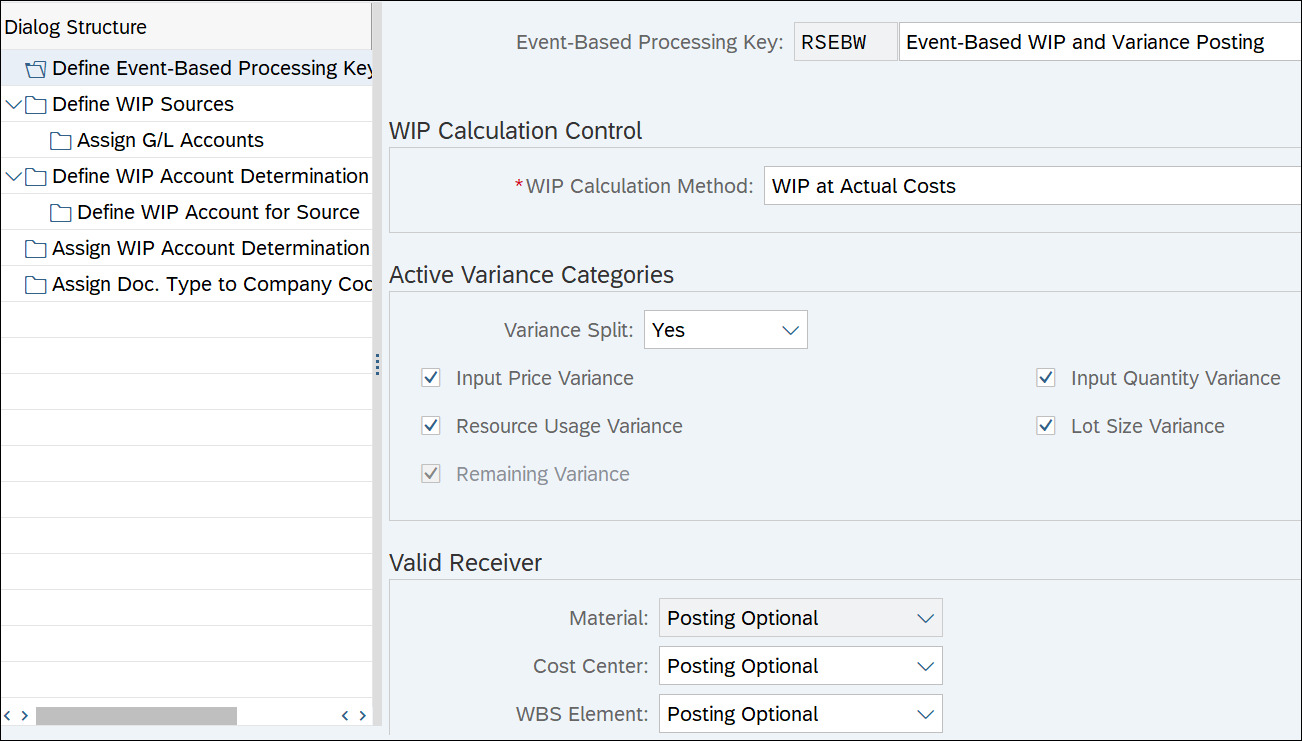
Figure 19.16 Event-based Processing Key for Product Cost by Order
By comparison, the event-based processing key for product cost by period shown in Figure 19.17 calculates WIP at target costs. In other words, WIP is calculated using the target costs for the operation recorded at the reporting point reached. Production variances are only split into Input Price Variance, Input Quantity Variance, and Resource Usage. The variance, the remaining variance, and all costs must be settled with the material. Suppose you don’t create any reporting points and record all goods issues and confirmations as a backflush on completion of the finished product. In that case, no WIP will be calculated; only variances will be calculated if changes are made to the standard BOM or routing quantities. These settings are also delivered with scope item 3F0 and have been available since SAP S/4HANA 2023.
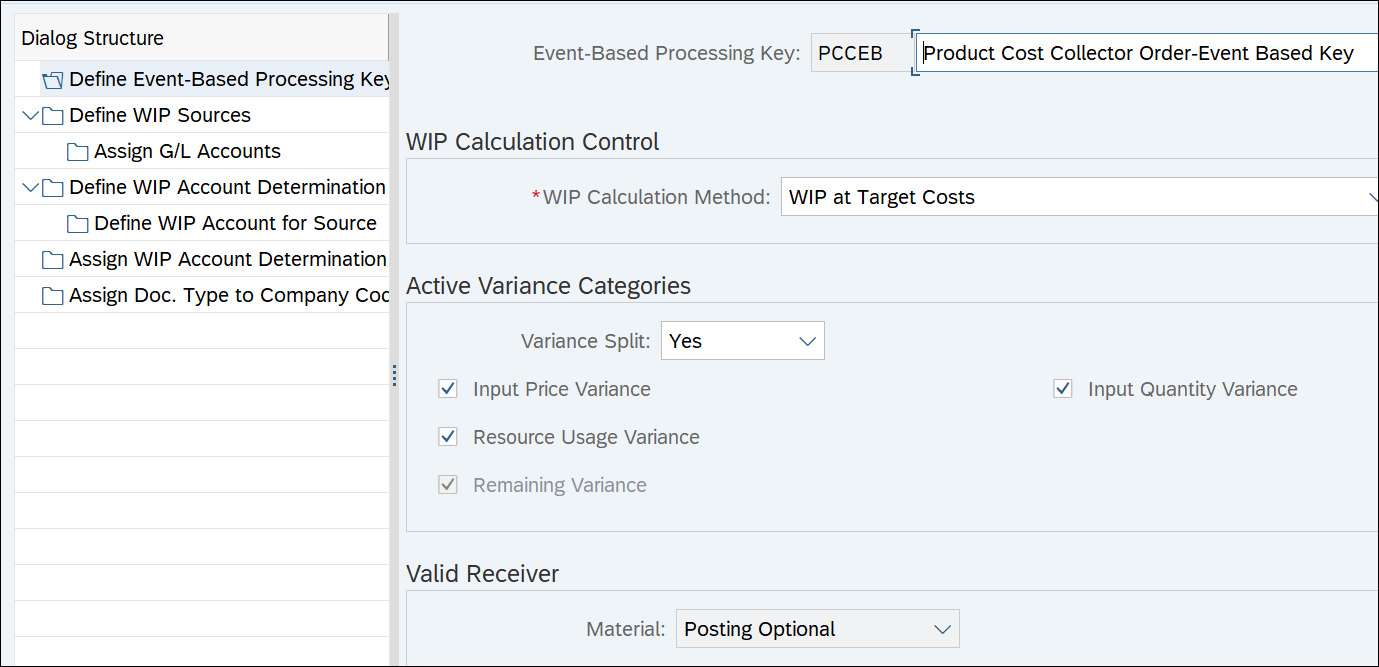
Figure 19.17 Event-Based Processing Key for Product Cost by Order
Unless you are working with the best-practice settings, you should check that all general ledger accounts for goods issues and confirmations of the orders and goods receipts on completion, together with follow-on costs for overhead, have been assigned to the delivered WIP sources, as shown in Figure 19.18.
The system will increase WIP for the values posted under the general ledger accounts for material cost (0MAT), labor cost (0LBR), and overhead cost (0OVH) and decrease WIP in proportion to the values posted under the general ledger accounts for delivered costs (0DLV).
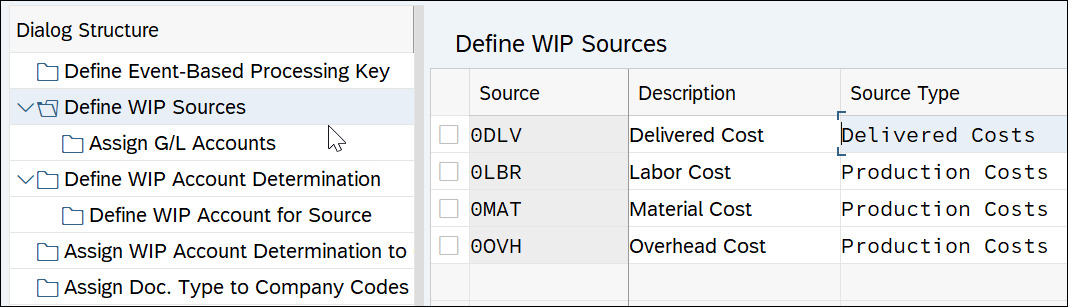
Figure 19.18 WIP Sources for Event-Based Processing
You should also check the general ledger accounts to be updated to account for WIP and reserves for unrealized costs for each of the WIP sources, as shown in Figure 19.19.
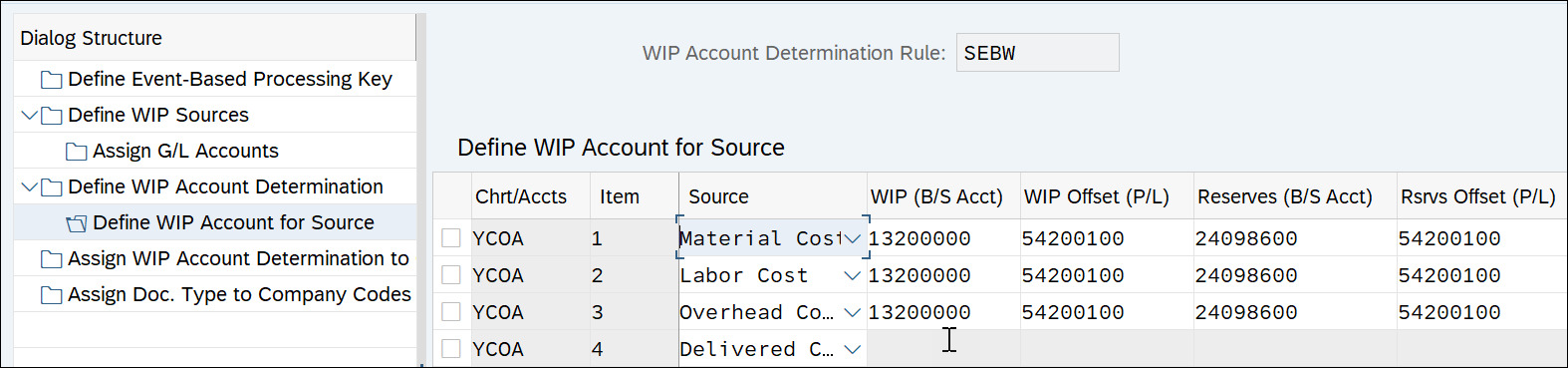
Figure 19.19 WIP Account Determination Rules
Event-Based Overhead
The rules for applying overhead are the same as those discussed in Chapter 5. The difference is that overhead is applied at a different point in time. The example in Figure 19.20 shows material overhead being calculated when the raw materials are issued to the production order. What’s important here is the link to the Reference document because it provides the link to the goods issue that resulted in the line item for material overhead. If the goods issue is cancelled, this link is needed to find and reverse the associated overhead and WIP. Notice also that these documents have a new business transaction type, KZPI. If you are involved in discussions about system sizing, bear in mind that an overhead document is created for each reference document rather than for the whole order during the period close and that this will result in extra documents, especially if you have many different confirmations and goods issues on a single order.
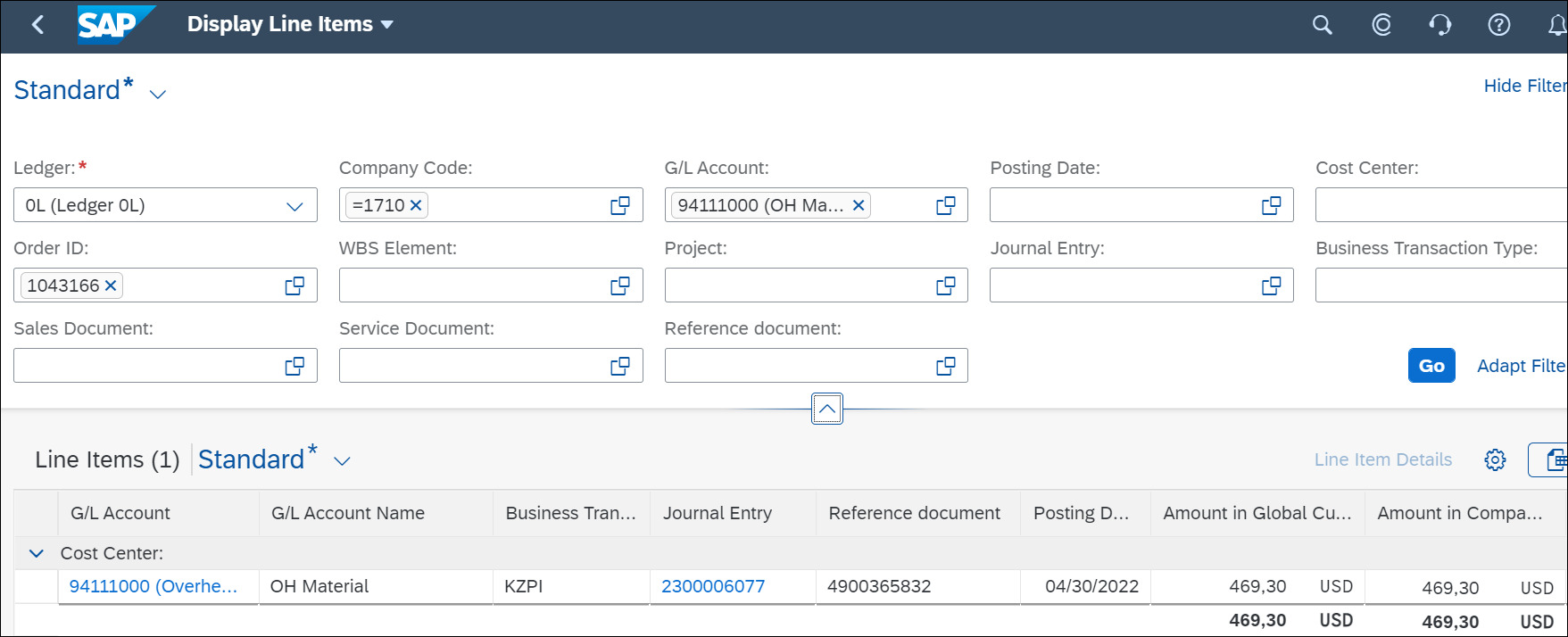
Figure 19.20 Line Item for Event-based Overhead
Event-Based Work in Process
Like overhead calculation, WIP is also associated with a reference document, so in Figure 19.21, we see two reference documents: one for the confirmation and one for the goods issue, and the associated WIP posting with the business transaction type EBWP. The WIP in the first line includes the activity costs for the operation confirmed and the production overhead, and the WIP in the second line contains the raw material costs for the goods issued at this operation and the material overhead (see Figure 19.20). In neither case was the WIP calculation triggered by the user. It was calculated automatically when the underlying reference document was posted. All the costs on order 1043166 are considered work in process because there has not yet been a stock delivery.
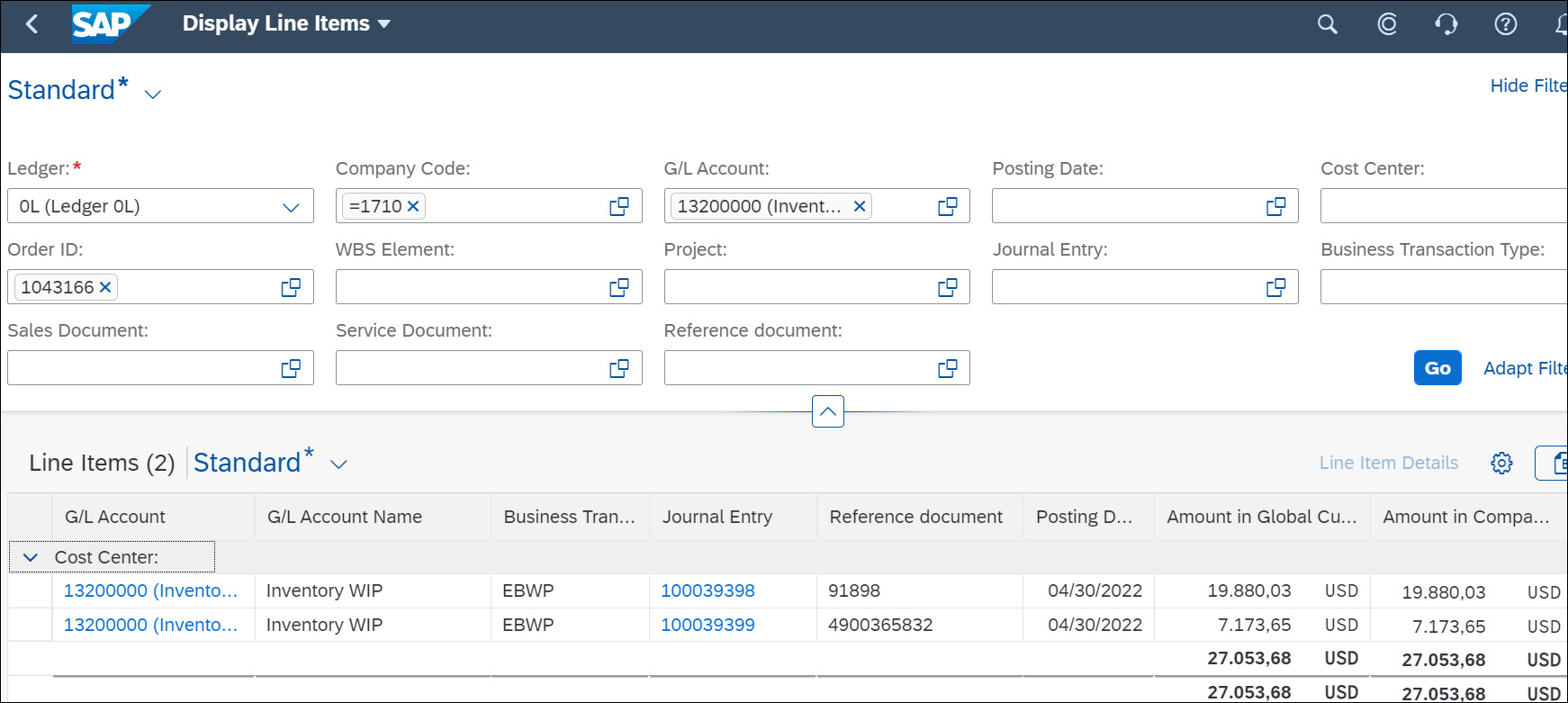
Figure 19.21 Line Items for Event-based WIP (Goods Issue and Confirmation)
Chapter 20: Product Cost Controlling Reporting
We examine the standard reports available for Product Cost Planning and Cost Object Controlling and how you can drill down from high-level summarization reports to detailed reports based on cost elements and line item reports. We also discuss the Production Order Information System and standard Cost Center Accounting (CCA) reports, as shown in Figure 20.

Figure 20: Standard Cost Center Report
SAP S/4HANA includes improvements in order summarization and line-item reporting. We also examine the Universal Journal, as shown in Figure 21.

Figure 21: Universal Journal Table ACDOCA
We examine SAP S/4HANA reporting improvements, including the Universal Journal as a single source of truth and SAP Fiori apps for financial and management accounting.
Legacy SAP ERP Enhancement Packages and Business Functions
For organizations transitioning from SAP ERP to SAP S/4HANA, it is useful to understand how Product Cost Controlling functionality evolved through Enhancement Packages (EHPs) and business functions.
Previously, SAP delivered new functionality through either Support Packages (SPs) or complete software upgrades and new versions. This process required functional teams to write test scripts with expected results and thoroughly test all methods used by the company to ensure none would be adversely affected. Coordination between different departments on the timing of an upgrade can be challenging, as finance departments often have distinct busy periods compared to sales and distribution or materials management. Consequently, many companies deferred the introduction of SPs or upgrades, missing out on the latest functionality and process improvements.
Now that we've discussed EHPs and business functions in general, we examine four specific business functions related to Product Costing and Controlling, such as FIN_CO_COGM:
1. FIN_CO_COGM: Multiple Valuation of Cost of Goods Manufactured
Available since SAP ERP EHP 5, this CO business function supports the valuation of the cost of goods manufactured (COGM) in multiple accounting approaches for depreciation, activity prices, and COGM and inventory values, described as follows:
- Transfer of depreciation from Asset Accounting to Controlling
The depreciation values for international accounting principles are updated to the leading ledger
GLOSSARY
Accrual Order
An accrual order enables you to monitor period-related accrual calculation between expenses posted in financial accounting and controlling.
Active Pharmaceutical Ingredient
An active pharmaceutical ingredient (API) is the substance in a drug that is pharmaceutically active and is by far the highest-cost ingredient in pharmaceutical products. One way to identify these costs is with a separate cost component by creating an API origin group and assigning it to API material masters with Transaction MM02 and an API cost component in the cost component structure with Transaction OKTZ.
Activity-Based Costing
While you typically allocate overhead costs during activity-type confirmations or with costing sheets, templates offer a more flexible alternative. Although setting up templates is more complex, they are set out logically and are worth considering as a flexible alternative for overhead costs.
Activity Type
An activity type identifies activities provided by a cost center to manufacturing orders. The secondary cost element associated with an activity type identifies the activity costs on the cost center and detailed reports.
Allocation Structure
An allocation structure allocates the costs incurred by a sender to specific cost elements or cost element groups. It is used for settlement and assessment purposes. An assignment maps a source cost element group to a settlement general ledger account.
Alternative Hierarchy
While there can only be one cost center standard hierarchy, you can create as many alternative hierarchies as you like. You create an alternative hierarchy by creating cost center groups.
Assembly Scrap
Assembly scrap is the percentage of assembly quantity that does not meet required quality standards. Assembly scrap is an output scrap because it increases the planned output quantity of items in the production process. You plan assembly scrap in the MRP1 view. It can be ignored with the Net ID checkbox in the basic data tab of a BOM item.
Automatic Account Assignment
Automatic account assignment enables you to specify a default cost center for each cost element within a plant using Transaction OKB9.
Availability Control
Availability control enables you to actively manage costs by issuing warnings and error messages when costs are incurred.
Backflushing
Backflushing is the automatic posting of a goods issue for components after their actual physical issue for use in an order. The goods issue posting of backflushed components is carried out automatically during confirmation.
Backflushing reduces the amount of work in warehouse management, especially for low-value parts. The material components from the BOM required in the operation should be assigned to the operations in the routing.
Base Quantity
All component quantities in a BOM relate to the base quantity. You increase the accuracy of component quantities by increasing the base quantity, similar in concept to the price unit.
Base Unit of Measure
Material stocks are managed in the base unit of measure. The system converts all quantities you enter in other units of measure (alternative units of measure) to the base unit of measure.
Bill of Material (BOM)
A bill of material is a structured hierarchy of components required to build an assembly or subassembly.
BOM Application
A BOM application is a costing variant component for automatic determination of alternative BOMs.
BOM Group
A BOM group is a collection of BOMs for a product or number of similar products.
BOM Item Component Quantity
The quantity of a BOM item that is entered in relation to the base quantity of the product.
BOM Item Status
Six indicators, such as costing relevancy, are contained in the Status/Long Text tab of a BOM item.
BOM Status
This controls the current processing status of the BOM. For example, a BOM may have a default status of not active when initially created, which then may be changed to active when the BOM is available for use in material requirements planning (MRP) and released for planned orders.
BOM Usage
This determines a section of your company, such as production, engineering, or costing. You define which item statuses can be used in each BOM usage; for example, all items in BOMs with a certain usage may be relevant to production.
BOMs, together with purchasing info records, allow cost estimates to calculate the material costs for assemblies.
By-Product
A by-product is a product that is produced in conjunction with other products. The system does not create a separate order item for each by-product. The material valuation of a by-product is always based on the price specified by price control in the material master. If a by-product is indicated as being relevant to costing in BOM, the total cost of the process is reduced by the costs of the by-products.
CKM3N - Material Price Analysis
CKM3N/CKM3 is used to analyze the price and cost components of a material in a plant, including variances and other Material Ledger values.
Co-Product
You select the co-product indicator in the MRP 2 and Costing 1 views if a material is a valuated product that is produced simultaneously with one or more other products. Setting this indicator allows you to assign the proportion of costs this material will receive in relation to other co-products within an apportionment structure.
Condition Type
A condition type is a key that identifies a condition. It indicates, for example, whether the system applies a price, a discount, a surcharge, or other pricing, such as freight costs and sales taxes.
Controlling Area Currency
You use the controlling area currency for cost accounting. You specify the controlling area currency when defining it in customizing for Controlling. You can assign multiple company codes with different currencies to a controlling area.
Cost Center
A cost center is master data that identifies where the cost occurred. At period end, a responsible person assigned to the cost center analyzes and explains cost center variances.
Cost Component
A cost component identifies costs of similar types, such as material, labor, and overhead, by grouping cost elements into the cost component structure.
Cost Component Group
Cost component groups allow you to display cost components in standard reports. In the most straightforward implementation, you create a cost component group for each component and assign each group to a corresponding cost component. You assign cost component groups as columns in cost estimate list reports and costed multilevel BOMs.
Cost Component Split
The cost component split refers to the combination of cost components that comprise the total cost of a material. For example, suppose you need to view three cost components— material, labor, and overhead —for your reporting requirements. In that case, the combination of these three cost components represents the split of these cost components.
Cost Component Structure
You define which cost components make up a cost component split by assigning them to a cost component structure. You assign cost elements and origin groups to cost components within the cost component structure.
Cost Component View
Each cost component is assigned to a cost component view. When you display a cost estimate, you can choose a cost component view, which filters the cost components displayed in the cost estimate.
Cost Element
Cost elements are included in a general ledger account. Primary cost elements identify external costs, while secondary cost elements identify costs allocated within Controlling, such as activity allocations from cost centers to manufacturing orders.
Cost Estimate
A cost estimate calculates the plan cost to manufacture a product or purchase a component. It determines material costs by multiplying BOM quantities by the standard price, labor costs by multiplying operation standard quantities by plan activity price, and overhead by costing sheet.
Cost Object
An SAP cost object, such as a cost center or internal order, describes where the cost occurs. A cost element or account describes what the cost is.
Costed Multilevel BOM
A costed multilevel BOM is a hierarchical overview of the values of all items of a costed material according to the material's costed quantity structure (BOM and routing). You display a costed multilevel Bill of Materials (BOM) on the left side of the cost estimate screen. You can also view a costed multilevel BOM separately with Transaction CK86_99.
Costing-Based Profitability Analysis
Costing-based profitability analysis enables you to evaluate market segments, which can be classified according to products, customers, orders (or any combination), or strategic business units, such as sales organizations or business areas concerning your company's profit or contribution margin.
Costing BOM
Costing BOMs are assigned a BOM usage of costing and are usually copied from BOMs with a production usage. You can adjust the costing BOMs to differ from the production BOMs if necessary. With system-supplied settings, standard cost estimates search for costing BOMs before production BOMs.
Costing Lot Size
The costing lot size should be close to actual purchase or production quantities to reduce lot size variance. Unfavorable variances may result if you create a production order for less than the costing lot size. Setup time is required to prepare equipment and machinery for production, and that preparation time is generally the same regardless of the quantity produced. Setup time spread over a smaller production quantity increases the unit cost. This applies to externally procured items because vendors typically quote higher unit prices for smaller amounts.
Costing Run
A costing run is a collective processing of cost estimates, which you maintain with Transaction CK40N.
Costing Sheet
A costing sheet summarizes the rules for allocating overhead from cost centers for cost estimates, product cost collectors, and manufacturing orders. The components of a costing sheet include the calculation base (a group of cost elements), the overhead rate (a percentage rate applied to the base), and the credit key (the cost center receiving credit).
Costing Type
The costing type determines if the cost estimate can update the standard price.
Costing Variant
The costing variant contains information on how a cost estimate calculates the standard price. For example, it determines whether the purchasing information record price is used for purchased materials or an estimated price is manually entered in the Planned Price 1 field of the Costing 2 view.
Currency Type
The currency type identifies the role of the currency such as local or global.
Demand Management
Demand management involves planning the quantities and dates of assemblies and defining the strategy for designing, producing, or procuring a finished product.
Dependent Requirements
Dependent requirements are caused by higher-level dependent and independent requirements when running MRP. Independent requirements, created by sales orders or manually planned independent requirement entries in demand management, determine lower-level dependent material requirements.
Deployment Options
SAP S/4HANA Cloud Private Edition:
SAP S/4HANA Cloud Private Edition is a managed cloud offering that enables a smooth, secure migration of an on-premise enterprise resource planning (ERP) system—including SAP ERP and SAP S/4HANA—to the cloud. This deployment option allows you to preserve your existing configuration, customization, and historical data from SAP ERP.
SAP S/4HANA Cloud Public Edition:
SAP S/4HANA Cloud Public Edition is a ready-to-run cloud ERP that delivers the latest industry best practices and continuous innovation. This deployment option is often abbreviated to SAP S/4HANA Cloud.
Detailed Reports
Detailed reports display cost element details of manufacturing orders and product cost collectors. During variance analysis, you can drill down on cost elements to display line-item reports.
Distribution Rule
You maintain distribution rules in settlement rules, as well as in manufacturing orders and product cost collectors.
Enhancement Package
A collection of new and improved business functions for SAP Business Suite and SAP ERP. These optional enhancement packages can be configured in a wholly modular fashion by activating only the latest features and functionalities customers want.
Event-Based Production Costing
As of SAP S/4HANA release 2022, event-based processing is available. Goods movements and confirmations represent events that trigger the calculation of overhead according to the costing sheet. Then, depending on the order's status, this triggers either the posting of a journal entry for the work in process (WIP) or the cancellation of any existing WIP and the calculation of production variances.
When moving to event-based production accounting, you can keep the overhead calculation rules we saw in Chapter 5, but you must flag your costing sheet as Evt. based, as shown for Costing Sheet 1010EP in Figure 19.15. It’s not possible to combine non-event-based costing sheets with event-based WIP because the assumption is that the creation of the reference document will trigger a first follow-on document for the overhead, followed by a follow-on document for either WIP or production variances, depending on the order status.
External Processing
An external vendor performs external processing of a manufacturing order operation. This is distinct from subcontracting, which involves sending material parts to an external vendor, who manufactures the complete assembly via a purchase order.
F.13 - Automatic Clearing
You use Transaction F.13 to automatically clear open items.
F.19 - Analyze GR/IR Account and Accrual
F.19 analyzes the GR/IR clearing account and posts adjustment entries for outstanding amounts to adjustment accounts. It makes the offsetting entry to the account for goods delivered but not invoiced or to the account for goods invoiced but not delivered.
FBL3N - G/L Account Line Item Display
FBL3N displays G/L line items only for the G/L accounts with the 'Display Line Item' checkbox selected.
FS10N - G/L Account Balance Display
This report lets you view the totals of a single or a range of G/L accounts. The totals are by month to give you an overview of how the account has changed. You access this report with transaction FS10N.
Goods Issue
A goods issue is the movement (removal) of goods or materials from inventory to manufacturing or a customer. When goods are issued, the inventory quantity is reduced.
Goods Receipt
A goods receipt is a goods movement used to post goods received from external vendors or in-plant production. Goods receipts for stock materials increase inventory quantities.
GR/IR
GR/IR is the SAP process for executing the three-way match—purchase order, goods receipt, and vendor invoice. You use a clearing account to record the offset of the goods receipt (GR) and invoice receipt (IR) postings. The postings are added to the clearing account balance as soon as they are completely processed.
GR/IR Account Maintenance
Transaction MR11 helps you correct the GR/IR balance when there is a difference in quantity (not price) between the invoice and the goods receipt. It should only be used when no more invoices or goods receipts are expected or can be posted.
Group Valuation
Group valuation aggregates legal entities while eliminating intercompany profits within the group.
Invoice Receipt
You enter a vendor invoice in SAP with Transaction MIRO or via menu path
Logistics - Materials Management - Logistic Invoice Verification - Document Entry - Enter Invoice.
Internal Order
An internal order monitors an organization's costs and revenue for short—to medium-term jobs. You can carry out planning at a cost element and detailed level, as well as budgeting at an overall level with availability control.
Legal Valuation
Represents the view of individual legal entities, showing transfers of goods according to strict legal reporting requirements.
Long-Term Planning
Long-term planning enables you to develop medium—to long-term production plans and simulate future production requirements using long-term MRP. You can also determine future purchasing requirements for vendor RFQs, update purchasing information records, and transfer planned activity requirements to cost center accounting.
Margin Analysis
Margin Analysis is the SAP S/4HANA evolution of account-based profitability analysis (account-based CO-PA). The Universal Journal combines financial and managerial accounting, recording all dimensions, including custom fields. Margin Analysis provides consistent financial information without requiring reconciliation and a comprehensive financial audit trail. All innovations developed for the Universal Journal are immediately available within Margin Analysis. A consistent approach ensures the common usage of ledgers, currencies, valuations, predictions, and simulations and their availability in planning and reporting.
Master Data
Master data is information that stays relatively constant over long periods. For example, purchasing information records typically contain vendor information, such as a business name, which remains relatively unchanged.
Material Ledger Drilldown Reporting
You access ML drilldown reporting with Transaction KKML0 via the following menu path:
Controlling - Product Cost Controlling - Actual Costing/Material Ledger - Material Ledger - Information System - Drilldown Reporting - Run Drilldown Report
Material Master
A material master contains all the information required to manage a material. Information is stored in views, each corresponding to a department or area of business responsibility. Views conveniently group information for users in different departments, such as sales and purchasing.
Material Requirements Planning (MRP)
MRP ensures material availability by monitoring stock levels and generating planned orders for Purchasing and Production.
MB5S - List of GR/IR Balances
MB5S displays differences between goods receipt (GR) and invoice receipt (IR) quantities and values.
ME23N - Display PO History
You use ME23N to display information about an existing purchase order to see whether the vendor invoice has been received and/or paid.
MR11SHOW - Display/Reverse MR11 Document
MR11 documents can be reversed using MR11_SHOW or by clicking on Account Maintenance, which documents the PO history. Be cautious if more than one PO has been corrected in an MR11 document, as it may reverse the entire document.
On-Premise
SAP S/4HANA On-Premise is deployed on infrastructure managed by the customer or its service provider and provides extensive control over configuration, customization, and upgrade schedules.
PA Transfer Structure
A PA transfer structure is used in costing-based CO-PA to assign costs and revenues from other applications to value and quantity fields in profitability analysis.
Process Order
A process order is a type of manufacturing order used in process industries. A master recipe and materials list are copied from the master data to the order. A process order contains operations that are divided into phases. A phase is a self-contained work step that defines the details of one part of the production process using a primary resource.
In process manufacturing, only phases are costed, not operations. A phase is assigned to a subordinate operation and contains standard activity values to determine dates, capacity requirements, and costs.
Procurement Alternative
A procurement alternative represents one of several methods for procuring a material. You can control the level of detail in which the procurement alternatives are represented through the controlling level. Depending on the processing category, there are single-level and multilevel procurement alternatives. For example, a purchase order is a single-level procurement, whereas production involves multilevel procurement.
Procurement Type
The procurement type in the MRP 2 view defines the material as assembled in-house, purchased externally, or both, as follows:
E: In-house production - A cost estimate will search for a BOM and routing.
F: External procurement - The system searches for a purchasing info record price.
X: Both - A planned order can be converted into a production or a purchase order.
Note: The special procurement type can be used to override the procurement type.
Product Cost Collector
A product cost collector collects target and actual costs during the manufacture of an assembly. Product cost collectors are necessary for repetitive manufacturing and optional for order-related manufacturing.
Production Order
For discrete manufacturing, a production order is used. A BOM and routing are copied from the master data to the order. The routing supplies a sequence of operations describing how to carry out work steps.
An operation refers to a work center where it is to be performed. It contains planned activities required to carry out the operation. Costs are based on the material components and activity price multiplied by a standard value.
Production Variance
Production variance represents the difference between the net actual costs debited to the order and the target costs based on the preliminary cost estimate and the quantity delivered to inventory. You calculate production variance with target cost version 1. Production variances are calculated for analysis and do not directly determine the settlement amount.
Production Version
A production version determines which alternative Bill of Materials (BOM) is used, along with which task list or master recipe, to produce a material or create a master production schedule. You can have multiple production versions with varying validity periods and lot-size ranges for one material.
Profit Center
A profit center receives postings parallel to cost centers and other master data, such as orders. Profit center accounting is integrated with the Universal Journal with S/4HANA. You usually create profit centers based on areas in a company that generate revenue and have a responsible manager.
Profit Center Valuation
Profit center valuation values goods exchanged between profit centers using transfer prices. Unlike group valuation, it explicitly records internal profits between profit centers.
Purchase Order
A purchase order is a legal contract that binds the supplier to provide the materials or services and the purchaser to pay upon receipt of the materials or services.
Purchase Price Variance
When raw materials are valued at the standard price, a purchase price variance will be posted during goods receipt if the goods receipt or invoice price differs from the material standard price.
Purchasing Info Record
A purchasing information record stores all the information relevant to procuring a material from a supplier. It contains the purchase price field, which the standard cost estimate uses to determine the purchase price.
SAP Universal Journal
The SAP S/4HANA Universal Journal provides a single source of financial and management accounting data. ACDOCA stores actual line items, while ACDOCP supports planning data.
SAP S/4HANA supports both period-end and event-based processing.
Special Procurement Type
The Special Procurement Type field, found immediately below the procurement type in the MRP 2 view, is used to define the procurement type more closely. For example, it may indicate if the item is produced in another plant and transferred to the plant you are analyzing. Special procurement type 30 indicates the material is procured by subcontracting.
Subcontracting
You supply component parts to an external vendor who manufactures the complete assembly. The vendor has previously supplied a quotation, which is entered in a purchasing info record with a subcontracting category.
Tracing Factor
Tracing factors determine the cost portions received by each receiver from senders during periodic allocations, such as assessments and distributions.
Unit Costing
Unit costing is a method that does not typically use BOMs or routings when developing new products. You create a preliminary structure of materials and activities in a view similar to a spreadsheet layout.
Valuation Approach
A valuation approach describes the values that are stored in accounting as a combination of a currency type (such as the group currency) and a valuation view (such as the profit center valuation view). The combination of various valuation approaches is known as a currency and valuation profile.
Valuation Class
The valuation class in the Costing 2 view determines which general ledger accounts are updated as a result of inventory movement or settlement.
Valuation Date
The valuation date determines which material and activity prices are selected when you create a cost estimate. Purchasing info records can contain different vendor-quoted prices for different dates. Different plan activity rates can be entered per fiscal period.
Valuation Grouping Code
The valuation grouping code allows you to assign the same general ledger account assignments across several plants with Transaction OMWD to minimize your work.
The grouping code can represent one or a group of plants.
Valuation Type
You use valuation types in the split valuation process, which enables the same material in a plant to have different valuations based on criteria such as batch. You assign valuation types to each valuation category, which specify the individual characteristics that exist for that valuation category. For example, you can valuate stocks of a material produced in-house separately from stocks of the same material purchased externally from vendors. You then select procurement type as the valuation category and internal and external as the valuation types.
Valuation Variant
The valuation variant is a costing variant component that allows different search strategies for materials, activity types, subcontracting, and external processing. For example, the search strategy for purchased and raw materials typically searches first for a price from the purchasing info record.
Valuation Variant for Scrap and WIP
This valuation variant allows you to select cost estimates for valuating scrap and WIP in a WIP-at-target-cost scenario. If the routing structure changes after a costing run, WIP can still be valued using the valuation variant for scrap and WIP, resulting in more accurate WIP valuation.
Valuation View
In the context of multiple valuation and transfer prices, you can define the following views:
- Legal valuation represents the view of individual legal entities, showing transfers of goods according to legal reporting requirements.
- Group valuation aggregates legal entities while eliminating intercompany profits within the group.
- Profit center valuation values goods exchanged between profit centers using transfer prices and explicitly records internal profits between profit centers.