
 SAP Advanced Intercompany Sales (AIS) in SAP S/4HANA handles a sale where one company code takes the customer order and a plant in another company code ships the goods. SAP creates an intercompany purchase order and sales order alongside the customer order, linking the internal sale to the customer delivery.
Follow the documents and inventory postings from the sales order through billing. The inventory postings depend on when control passes to the selling company and when it passes to the customer.
What Is SAP Advanced Intercompany Sales?
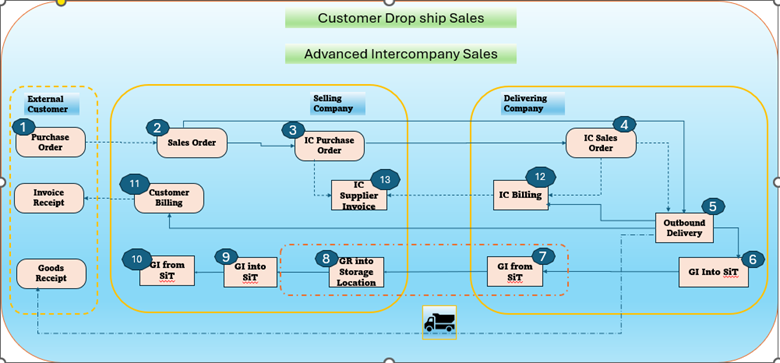
The delivering company ships directly to the customer and bills the selling company. The selling company bills the customer. Compared with classic intercompany sales, the advanced process adds linked intercompany purchasing and sales documents and uses valuated stock in transit to track the transfer of control. Figure 1 shows how the documents connect.
SAP documents Advanced Intercompany Sales as scope item 5D2 for SAP S/4HANA 2022 and provides separate setup guidance for Public Edition. Check the scope and prerequisites for your release and deployment.
How the Document Flow Works
- Create the customer sales order. The selling company enters the order and uses a delivering plant assigned to another company code. With AIS configured, the customer order starts the value chain.
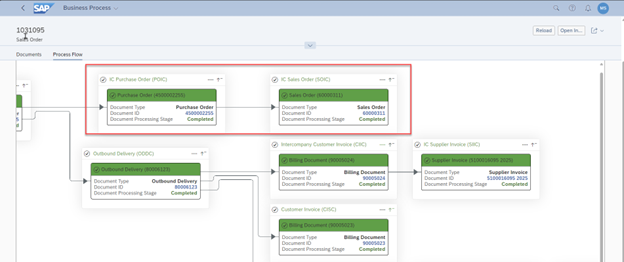
- Generate the intercompany orders. SAP creates a purchase order in the selling company and a corresponding sales order in the delivering company. Figure 2 shows the order pair.
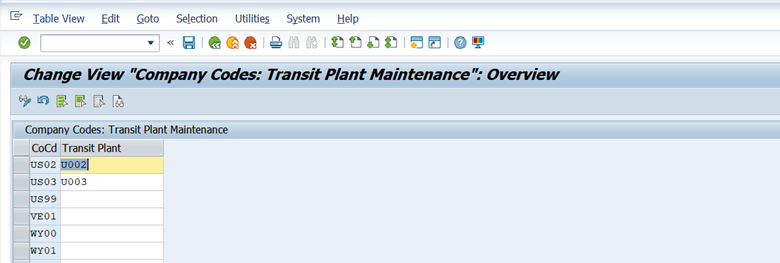
- Use the selling company’s transit plant. The purchase order identifies the transit plant shown in Figure 3. The plant represents the selling company’s inventory for valuation and account assignment while the delivering plant handles physical shipment.
- Ship to the customer. The delivering plant creates the outbound delivery against the customer order and posts goods issue. Transfer-of-control events govern the subsequent stock postings.
For a companion walkthrough, see SAP Advanced Intercompany Sales in S/4HANA: An Introduction.
Pricing, Monitoring, and Reconciliation
Check the Internal and External Prices
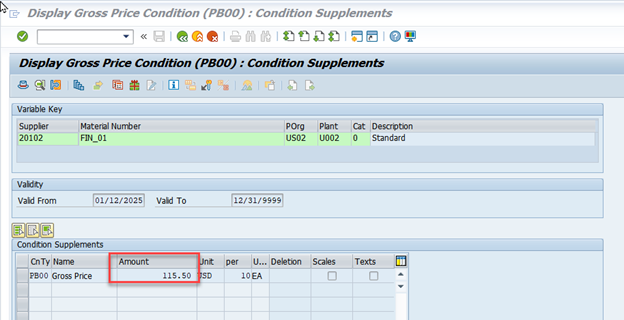
Check the internal transfer price separately from the price charged to the external customer. Figure 4 shows a transfer price maintained in a purchasing info record for the intercompany purchase order. Compare the internal pricing conditions and amounts across the purchase order, intercompany sales order, and intercompany invoice.
Trace Exceptions in Monitor Value Chains
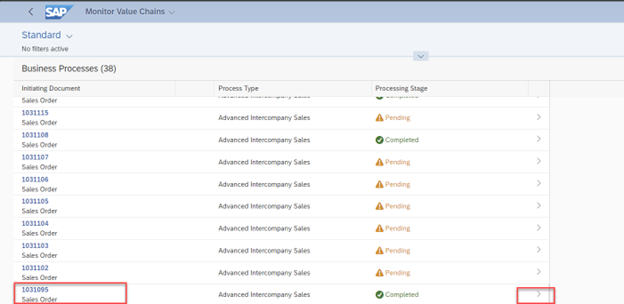
Use the Monitor Value Chains app to find related documents and see which steps have completed. Figure 5 shows the app. When a posting or invoice is missing, start with the first incomplete step and check its preceding document, transfer-of-control date, or posting status.
Valuated Stock in Transit and Transfer of Control
SAP uses internal and external transfer-of-control dates to drive valuated stock in transit (VSiT) postings. The internal date represents control passing between the affiliated companies. The external date represents control passing from the selling company to the customer. These events can occur at different points in the shipment.
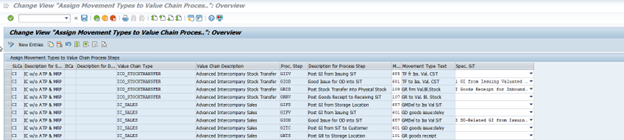
Figure 6 shows the movement types used in this example. Figure 7 illustrates the stock sequence, summarized below.
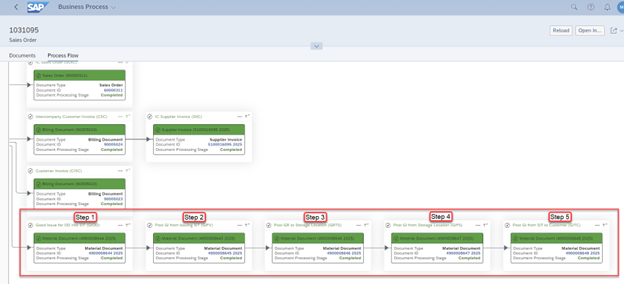
- Goods issue at shipment. The delivering plant moves unrestricted stock into its valuated stock in transit.
- Internal transfer of control. SAP clears the delivering plant’s stock in transit and records the intercompany cost of goods sold in the delivering company. In the example, the selling company receives the goods into unrestricted stock at its transit plant, then moves them into its stock in transit.
- External transfer of control. SAP clears the selling company’s stock in transit and posts its cost of goods sold for the customer sale.
Billing and Supplier Invoices
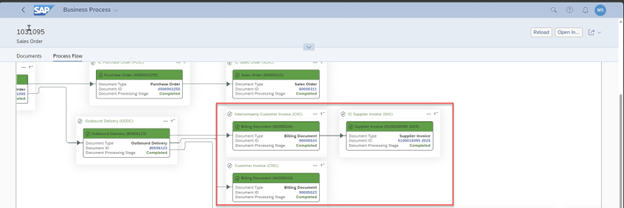
Table 1 identifies who bills whom. Figure 8 shows the billing and supplier invoice documents in the flow.
| Document | Company Code | Purpose |
|---|---|---|
| Customer Invoice (F2) | Selling company | Bills the external customer. |
| Intercompany Customer Invoice (IV2) | Delivering company | Bills the selling company for the internal sale. |
| Intercompany Supplier Invoice | Selling company | Records the payable to the delivering company based on the intercompany customer invoice. |
Review SAP’s Advanced Intercompany Sales billing documentation for document prerequisites and invoice processing details.
When to Use Advanced Intercompany Sales
A typical use case is a sales company fulfilling a customer order from an affiliated manufacturing or distribution plant. This occurs in manufacturing, wholesale distribution, and pharmaceuticals. If the business starts with one affiliate ordering inventory for its own plant, evaluate Advanced Intercompany Stock Transfer as a separate process.
Conclusion
When testing AIS, reconcile the two intercompany orders, the inventory and cost postings at both transfer-of-control dates, and the three billing documents. Sales, Logistics, and Finance can use those checks to confirm the transaction completed across both company codes.
Glossary
- Advanced Intercompany Sales (AIS)
- The SAP S/4HANA process for an external customer sale that an affiliated company fulfills.
- Intercompany Transfer Price
- The price the delivering company charges the selling company for the goods.
- Transfer of Control
- The event when control of the goods passes between company codes or from the selling company to the customer.
- Transit Plant
- The plant in the selling company used to manage and value the goods in the intercompany flow.
- Valuated Stock in Transit (VSiT)
- Inventory that remains on a company’s books while the goods are in transit and that company still controls them.
Need Help With SAP S/4HANA Finance and Controlling?
ERPCorp helps companies optimize SAP Finance, Controlling, Product Costing, and S/4HANA processes. Explore SAP Consulting Services.
Watch Surajit Mohanty’s presentation Advanced Intercompany Sales and SIT with ERPCorp SAP membership.